From precision medicine to networking; Reflections on the Festival of Genomics
by Raphael Hans Lwesya (Quadram Institute)
I attended the Festival of Genomics and Biodata in London at ExCeL on 28th and 29th January 2026. Festival of Genomics brings together people from academia, research institutes, medicine, tech companies, and policy. As a PhD student, it was an amazing opportunity where you get to learn, network, and appreciate where the field is heading.
Presenting research on the gut virome
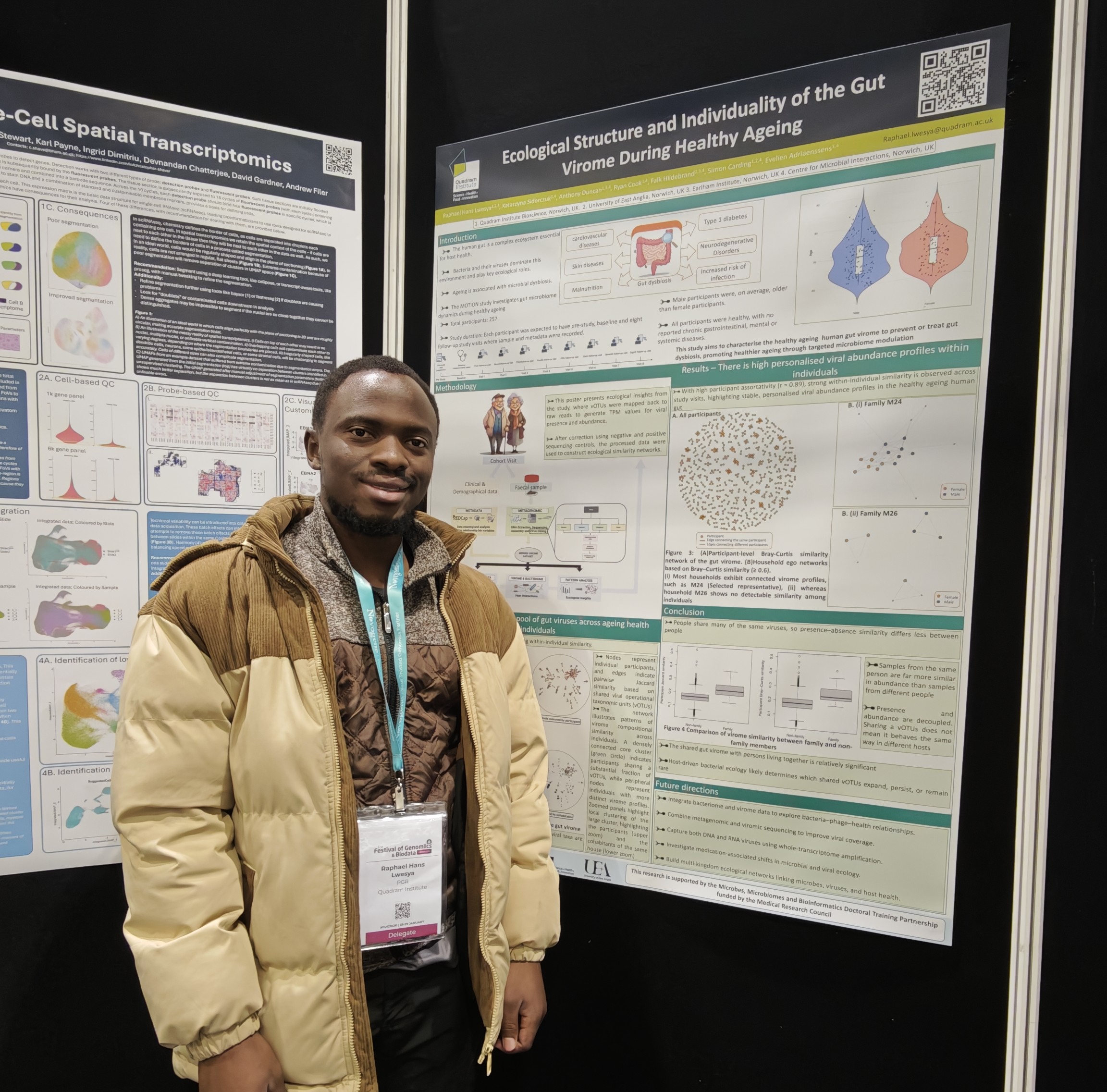
One of the highlights for me was presenting my own research through a poster. I presented a part of my work which focused on how individual gut bacteria and viruses are connected within a person and between people, including an analysis of the gut virome structure within families.
The chance to share that with a diverse of audience was both exciting and a little nerve-wracking.
The event covered a wide range of topics but my main interests were multi-omics, science policy, microbiology and biodata. Given the wide range of parallel talk sessions, I had to be strategic about which ones to attend – a good problem to have!
Learning about precision medicine and policy
On the first day, Minister Zubir Ahmed, Parliamentary Under-Secretary of State for Health Innovation and Safety, delivered a keynote address on precision medicine and its role in reshaping diagnosis and treatment. This talk was very interesting and gave me a view on the ambitious strategy the UK is pursuing and what is happening at the government policy level.
At the Biodata Stage, I saw a talk from Our Future Health that was particularly relevant to my own project. The speakers gave an interesting overview of health ageing, with the core message that data is central to helping people live longer and healthier lives.
I also spent a good amount of time at the Bacteria, Bugs & Big Data Stage. One talk that stood out was from Dr Esther van Kleef, a Senior Research Associate from the University of Oxford, whose work integrates genomic data to improve infectious disease surveillance and inform policies to reduce the burden of drug resistance. It was great to see how foundational the science we do in the lab can be when it scales up to driving policies.
Networking with professionals; from LEGO to public health
The networking sessions were something I made the most of too. There is something quite different about talking to a scientist face-to-face versus reading their paper, and I had some useful conversations, both with people I had known for a while, and with a few I had only just met after their talks.
The conference showed me how others are tackling the challenge of managing large volumes of genomic and metadata. Discussing with these people directly on how they handle big data pipelines gave me some fresh ideas about things I could improve in my own analysis workflow. For example, I had a good conversation with representatives from Public Health Wales who described how they use data for disease surveillance.
On the exhibition floor, I came across a stand that caught my eye related to science communication – a campaign gathering signatories to petition LEGO to create a DNA set. It was a very creative and unique way to engage with the community through enjoyment and a sense of accomplishment while teaching about fundamental science.
Another stand that I found exciting was Opentrons. They were showcasing their robotic liquid handling platform, and what impressed me was hearing about the improvements they had made to their previous version, while still keeping the flexibility for custom programming. As someone whose work involves some repetitive liquid handling procedures, I found it very useful.
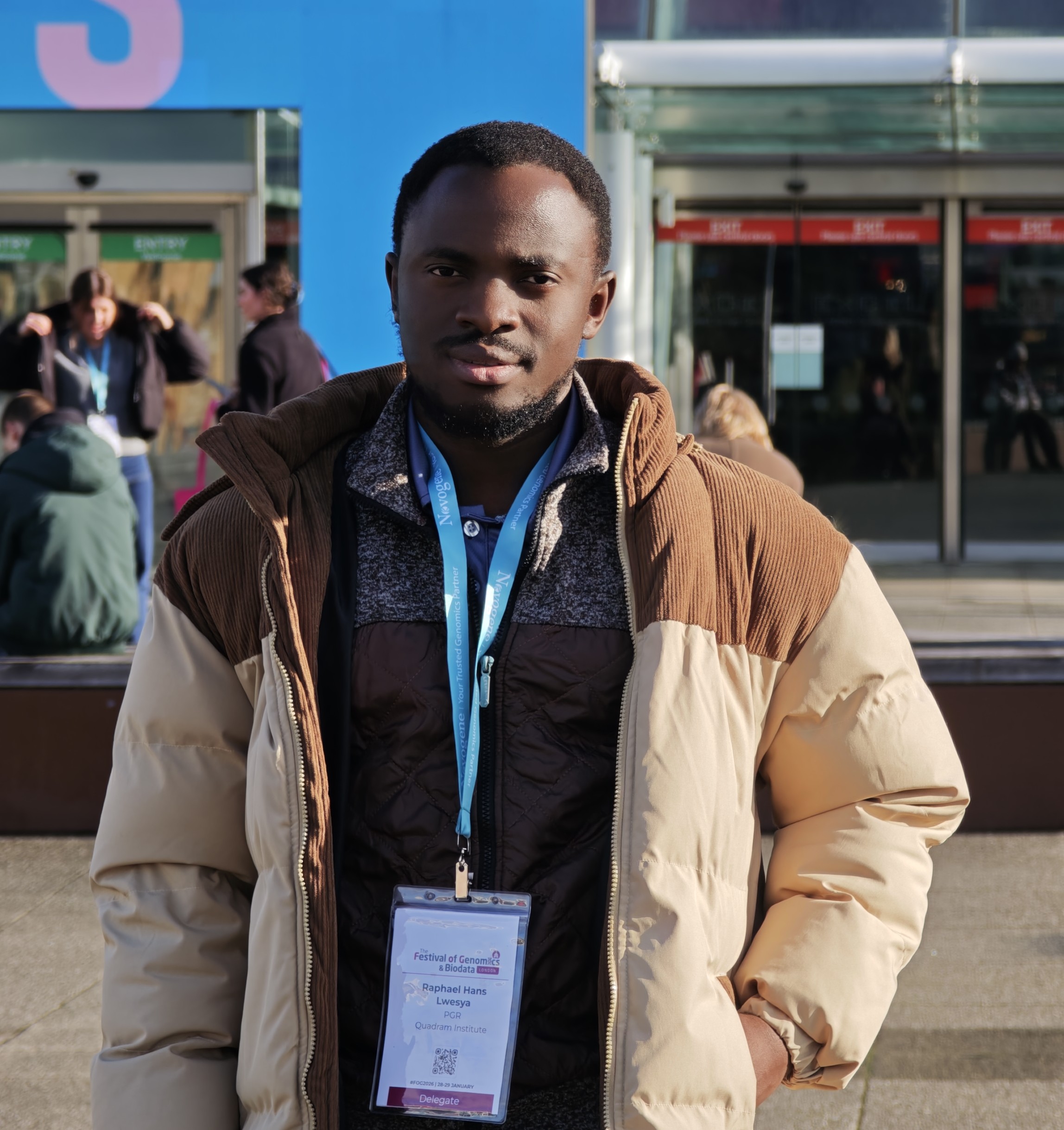
Overall, the Festival of Genomics was a great event. I made new connections with people who were interested in my work, discovered companies and tools I had not come across before, and picked up new approaches that I have tried to implement in my work. There was also a strong entrepreneurial energy throughout.
After the conference, I took some time to enjoy the surroundings. ExCeL is conveniently located near London City Airport, the River Thames and the London Skyline. I also managed to do a bit of plane watching and birdwatching despite the urban setting. A small but welcome bonus.
A sincere thank you to the Centre for Microbial Interactions for the funding that made it possible for me to attend.