The Microbe Zoo
Something big about something very small is coming to this year’s Royal Society Summer Science Exhibition.
The Centre for Microbial Interactions and the SAW Trust are excited to present The Microbe Zoo at the Royal Society Summer Science Exhibition 2026, the free annual celebration of cutting-edge science taking place in London from 30th June to 5th July.
What is the Microbe Zoo?
The Microbe Zoo is a new interactive and immersive exhibit that takes you on a guided tour through the world of microbes that live around us, on us and even inside of us.
Everywhere on Earth has its own population of microbes, but their miniscule scale means that we usually can’t see them. Despite this, microbes play a vital role in supplying our food, keeping us healthy and shaping the environment and climate.
The Microbe Zoo showcases this huge diversity of bacteria, viruses, fungi, algae and other microbes by ‘shrinking’ visitors down to their tiny scale. Once immersed in different microbial environments, a range of sounds, lights, interactive games and visuals will show how microbes can be both a positive force for the planet or negatively impact our lives. We’re excited to demonstrate how scientific research holds the key to living better in the microbial world.

Your visit to the Microbe Zoo
Much like a regular zoo, a visit to the Microbe Zoo takes you on a journey through different ecosystems to meet what lives there, only this time on the microscopic scale.
On a trip through the soil, you’ll see how plants communicate with microbes to enlist their help accessing the nutrients needed to grow and produce food for our plates.
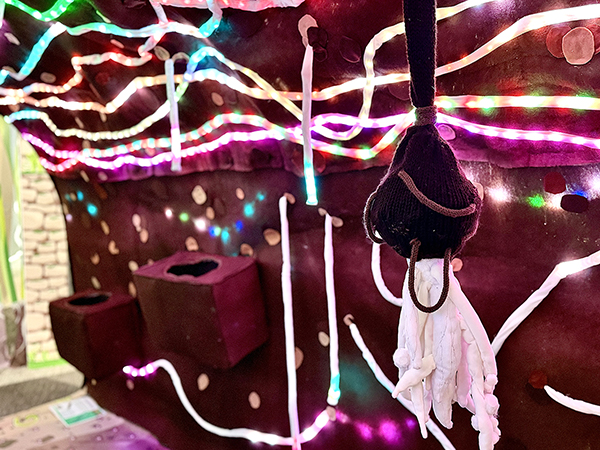
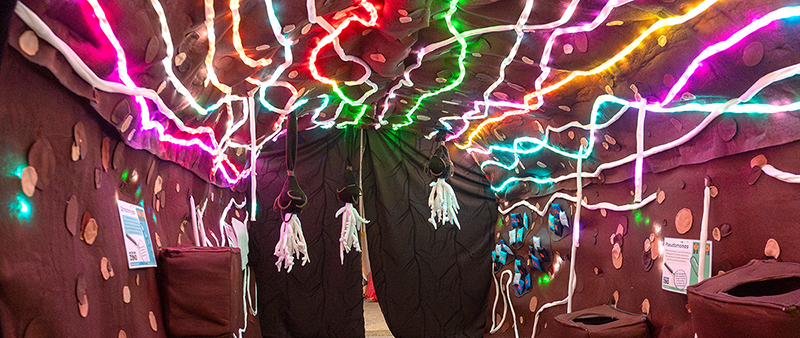
You’ll follow that food on its way through the human gut to meet its resident microbiome. See how fibre and a diet rich in vegetables support this microbial population, which in turn keeps us healthy. You’ll also see how invading microbes can cause disease, and how the latest research breakthroughs could replace antibiotics in battling infections.
Beyond the gut, take a dive into the waterways to investigate the environmental challenges of sewage and runoff from landfill or agriculture. How can advances in microbial research help us build a sustainable ecological balance in our rivers?
No trip to the zoo would be complete without a visit to our mock café and gift shop, but of course with a microbial twist. Learn about how many of our everyday foods and household products are made by microbes before you collect our free activity book with experiments to try at home.
The Microbe Zookeepers
The Microbe Zoo is run by knowledgeable experts who will act as your tour guides through the exhibit. They can answer your questions and chat about all things microbiology, as well as ensuring the exhibit is accessible for all.
Our zookeepers are drawn from the Centre for Microbial Interactions, which represents one of the world’s largest clusters of microbiologists working at the world-class institutes across Norwich Research Park.
When they’re not guiding you through the Microbe Zoo, they’re harnessing microbiology to tackle global challenges in health, agriculture, food, energy and climate.
- Revathy and Arezoo are part of a group working at the Quadram Institute studying bacteriophages, which are viruses that infect bacteria. There are more bacteriophages in the human gut microbiome than bacteria and we want to find out what they’re doing (read more about phages in the microbiome here). Can we also harness the way they infect bacteria to combat disease-causing bacteria that are resistant to antibiotics? (read more about phages targeting infections here)
- Researchers from the University of East Anglia discovered that a common type of ocean algae produce an abundance of a compound called dimethylsulfoniopropionate, or DMSP. This breaks down into a gas that forms the characteristic smell of the sea, but it also plays a vital role in balancing the planet’s climate. (Read more about how these algae help cool the planet here)
- John Innes Centre scientists are studying naturally occurring soil bacteria that can protect plants against disease and promote their growth. Harnessing the soil microbiome for crop health promises to reduce the use of environmentally harmful agrochemicals and reduce the generation of greenhouse gases like N2O (Read more about how researchers are advancing plant health here)
How we built a (microbe) zoo
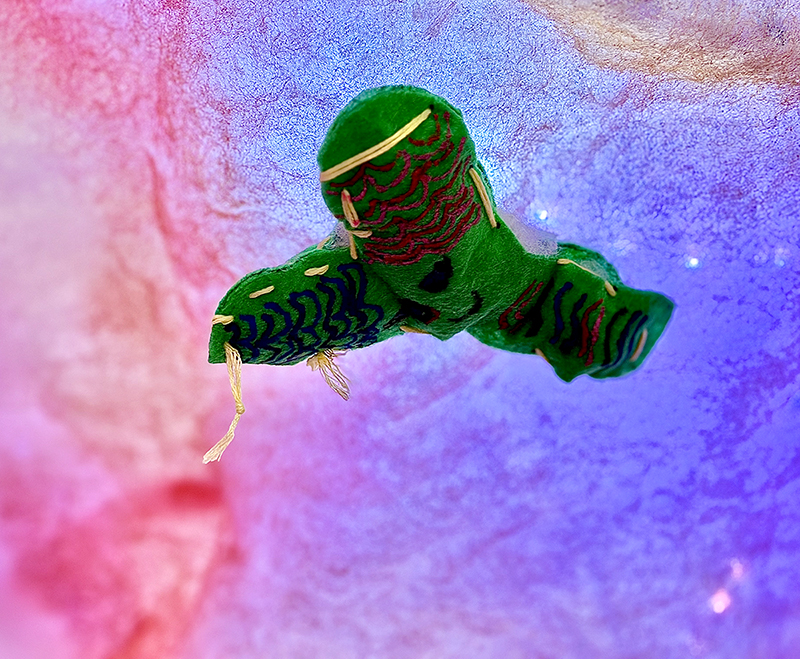
The Centre for Microbial Interactions teamed up with science education charity the SAW (Science Art Writing) Trust and an artist-led organisation in Great Yarmouth called originalprojects;. They work with local contemporary artists and communities to create exhibitions and installations.
The team helped scale up the artistic vision and bring to life our microbial stories, all sourced from ongoing research projects within the Centre for Microbial Interactions:
- Quadram Institute – deliver healthier lives through innovation in gut health, microbiology and food
- John Innes Centre – excellence in plant and microbial science
- Earlham Institute – harnessing the power of data-driven biology to accelerate solutions for health, biodiversity, and food security
- The Sainsbury Laboratory – fundamental and applied scientific research into molecular plant-microbe interactions.
- University of East Anglia – a UK top 30 University with globally-recognised research expertise
- Norfolk and Norwich University Hospitals – a research-focussed NHS Foundation Trust with excellence in chronic diseases, paediatrics, older peoples’ medicine and microbiology
We are incredibly grateful to the John Innes Foundation as our founding sponsor for making the Microbe Zoo project possible.
We would also like to thank Norwich Freemen’s Charity for their funding and all the Norwich Research Park Partners for their additional vital support.




Visit The Microbe Zoo at the Royal Society Summer Science Exhibition 2026, in London from 30th June to 5th July.
Entrance to the exhibition is free, and suitable for all ages. Check their website for full details of opening times and all of the other exhibits showcasing the cutting edge scientific research going on across the UK.